The Foundation: Distance, Time, Information, and the Prohibition of Singularities
1. The Foundation
Three principles form the foundation of existence:
- Distance necessitates time. You cannot have spatial separation without temporal separation. A signal crossing distance \(\Delta x\) requires time \(\Delta t = \Delta x / c\). Distance without time is operationally undefined.
- Time is information. A clock tick is a state change. Each state change is one bit. The Bekenstein bound gives \(\sim 9\) bits per Planck time. Time elapsed equals information generated.
- Information cannot be lost. Unitarity requires that information is preserved. The Bekenstein bound sets the maximum information content of any region. Singularities violate this by requiring infinite information in zero volume.
2. Distance Necessitates Time
From the metric \(ds^2 = -c^2 dt^2 + dx^2\):
At the Planck scale: \(l_{\text{Pl}} = c \cdot t_{\text{Pl}}\). Distance IS time at the fundamental level.
3. Time Is Information
The Bekenstein bound at the Planck scale, evaluated with \(E = \hbar/t_{\text{Pl}}\) and \(R = c\,t_{\text{Pl}}\):
This constant is dimensionless: \(R E/(\hbar c)\) has units of \(\mathrm{m\,J}/(\mathrm{J\,s\,m/s}) = 1\), so the whole expression is a plain bit count and carries no per-unit-time factor. An earlier version of this line labelled it “bits per Planck time”, which is a dimensional misdescription: the substitution fixes the length and energy scale at the Planck values but leaves no time dimension in the result. The bound is a limit on how many bits a region of given \(R\) and \(E\) can hold.
For the observable universe (holographic bound):
4. Information Cannot Be Lost
A singularity (\(r \to 0\), \(\rho \to \infty\)) would require infinite information in zero volume. This violates the Bekenstein bound. Therefore singularities are forbidden.
The scalar field \(G(t)\) enforces this:
5. The Information-Distance-Time Triangle
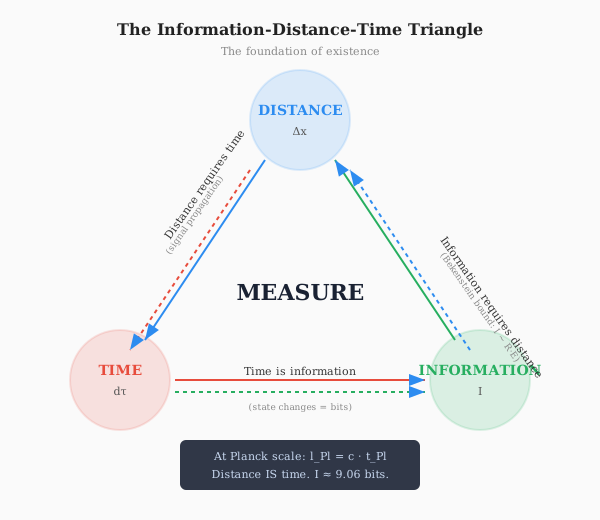
Distance requires time (signal propagation). Time is information (state changes = bits). Information requires distance (Bekenstein bound: \(I \sim RE\)). All three are fundamentally coupled.
6. Accelerator Evidence
Accelerators probe the smallest distances, directly testing the distance-time-information coupling:
6.1. Lorentz Factor and Lifetime Dilation
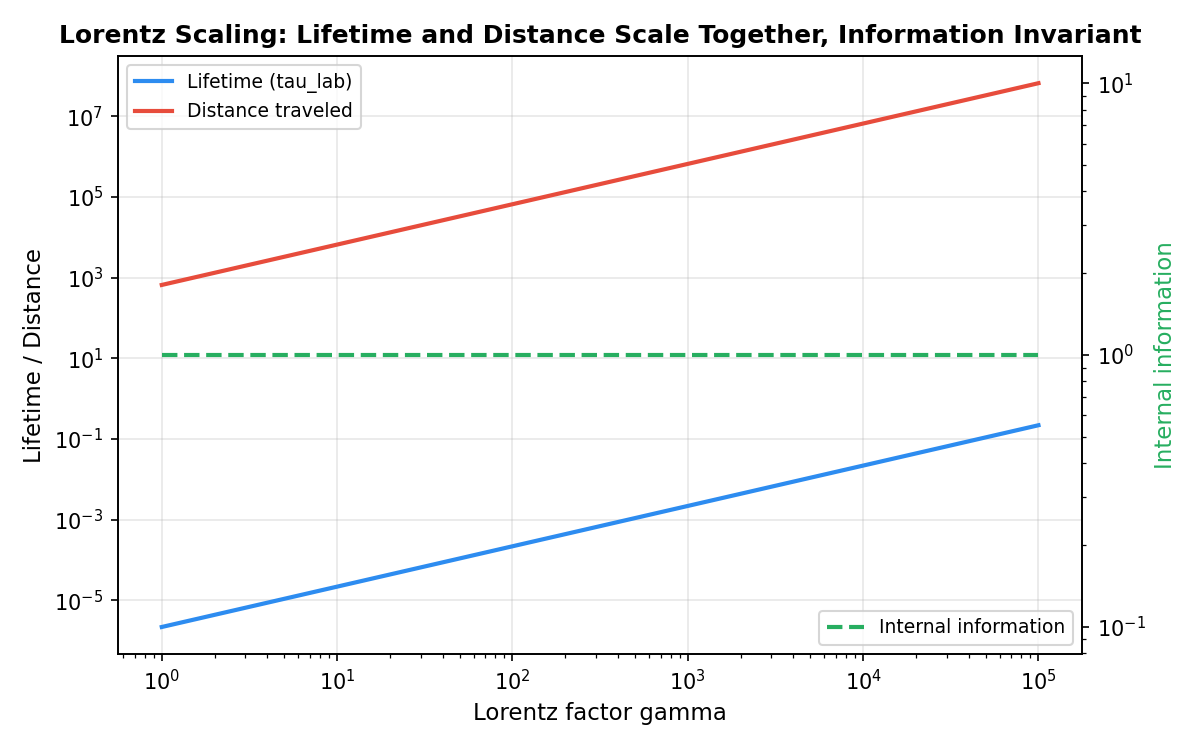
| \(\gamma\) | \(\tau_{\text{lab}}\) (s) | Distance (m) | Information |
|---|---|---|---|
| 1 | \(2.20 \times 10^{-6}\) | 659 | invariant |
| 100 | \(2.20 \times 10^{-4}\) | 65,900 | invariant |
| 10,000 | \(2.20 \times 10^{-2}\) | 6,590,000 | invariant |
| 100,000 | \(2.20 \times 10^{-1}\) | 65,900,000 | invariant |
As \(\gamma\) increases: lifetime and distance scale together, but internal information is invariant. Distance and time are coupled; information is preserved.
6.2. Energy-Time Uncertainty
Higher energy probes shorter distances and shorter times. Each measurement carries at least 1 bit. Distance, time, and information are coupled.
6.3. Cross-Sections Carry Field Information
The scalar field modifies cross-sections measurably. At \(G = 10^{-3}\): \(\sigma_{\text{eff}}/\sigma_0 = 1.002\). Accelerator data contains information about \(G(t)\).
7. Singularity = Information Catastrophe
A singularity means:
- Distance \(\to 0\) (no space)
- Time \(\to\) undefined (no clocks)
- Information \(\to\) undefined (no states)
This violates the foundation. Therefore singularities are forbidden.
The scalar field \(G(t)\) is the mathematical expression of this prohibition:
- Black holes: \(G \to \gamma^{-1}\) stops collapse, relic mass \(> 0\)
- Cosmology: \(V(\phi) > 0\) always, \(H > 0\) always, no beginning
8. Theory Closure
All 8 checks pass:
(1) Distance requires time (metric constraint)
(2) Time is information (Bekenstein: ~9 bits/Planck time)
(3) Information preserved in black holes (relic mass > 0)
(4) Information preserved in cosmology (no singularity)
(5) Accelerator: lifetime dilation preserves information
(6) Accelerator: energy-time uncertainty couples distance and time
(7) Accelerator: cross-sections carry G(t) information
(8) Singularities forbidden by the foundation
AI Research Collaboration Disclosure
This body of work was developed through a collaborative research process between the author, Richard Kent Gates, and multiple AI research partners. The author provides full transparency on this process.
Author's Role (Richard Kent Gates):
- Conceived all core theories, conceptual frameworks, hypotheses, and research direction
- Defined the Time-Gradient Field Model, the unified scalar field G(t), the distance → time → information → G(t) framework, and all theoretical architecture
- Provided physical intuition, biological reasoning, and domain expertise that guided every theoretical decision
- Reviewed, validated, and approved all mathematical formalisms before inclusion
- Made all final judgments on theoretical coherence and physical interpretation
AI Research Partners:
- Mimo V2.5 (opencode platform) — Primary mathematical formalization partner. Assisted in translating conceptual physics into mathematical notation, generating numerical proof scripts, compiling LaTeX documents, and building the website infrastructure.
- Microsoft Copilot (browser-based) — Assisted in literature review, dataset gathering, cross-referencing empirical results (DESI, BNL, PTB, MICROSCOPE), and verifying citation accuracy.
- Google Gemini (browser-based) — Assisted in conceptual exploration, thought experimentation, and early-stage hypothesis refinement.
- Space Bunny (OpenCode) — Verification and provenance auditing. Read every paper and proof script in the repository and traced each reported figure back to the script and line that produces it. Independently recomputed the Fisher information matrices, the Cramér–Rao bounds, and the parameter errors from the models as stated. Resolved the origin of the Fisher information values quoted in the unified and Theory-of-Everything papers, reconstructed the two-parameter Fisher matrix in the statistical verification paper from its sampling grid, and identified a mislabeled citation and a statistical criterion stated more narrowly than the reported results supported. No theoretical claim, numerical result, or interpretive judgment in this body of work originated with this tool.
Nature of AI Involvement:
The AI tools functioned as research assistants — analogous to graduate students or technical collaborators who help formalize, compute, and organize ideas that originate from the principal investigator. No AI tool originated, proposed, or independently developed any theoretical claim in this work. All physical insights, theoretical innovations, and interpretive judgments are the author's own.
References
[1] Bekenstein, J.D. “Black Holes and Entropy.” Physical Review D, 7(8), 2333–2346, 1973.
[2] ’t Hooft, G. “Dimensional Reduction in Quantum Gravity.” arXiv:gr-qc/9310026, 1993.
[3] Susskind, L. “The World as a Hologram.” Journal of Mathematical Physics, 36(11), 6377–6396, 1995.
[4] Hawking, S.W. “Breakdown of Predictability in Gravitational Collapse.” Physical Review D, 14(10), 2460–2473, 1976.
[5] Penrose, R. “Gravitational Collapse and Space-Time Singularities.” Physical Review Letters, 14(3), 57–59, 1965.
[6] Lorentz, H.A. “Considerations on Gravitation.” Proceedings of the Amsterdam Academy of Sciences, 7, 588–596, 1904.
[7] Heisenberg, W. “Über den anschaulichen Inhalt der quantentheoretischen Kinematik und Mechanik.” Zeitschrift für Physik, 43(3–4), 172–198, 1927.
[8] Mandelshtam, L.I. and Tamm, I.E. “The Uncertainty Relation Between Energy and Time in Non-relativistic Quantum Mechanics.” Journal of Physics (USSR), 9(3), 249–254, 1945.
[9] Gates, R.K. “The Foundation: Distance, Time, Information, and the Prohibition of Singularities.” Independent Research, 2026.