The Theory of Everything
1. The Axiom
Time is information.
Information cannot be lost.
This single axiom generates quantum mechanics (information = bits = quantum states), general relativity (distance = time = spacetime), thermodynamics (information preserved = entropy arrow), and the scalar field \(G(t)\) (the mathematical expression of the axiom).
2. The Field
The scalar field:
The field IS the quantum vacuum. The quantum vacuum IS spacetime. They were never separate. They were always the same thing described at different scales.
- GR sees: spacetime curvature (large-scale field gradient)
- QM sees: vacuum fluctuations (small-scale field oscillation)
- Both see: the same field, the same law, all scales

3. The Correction Law (The Bridge)
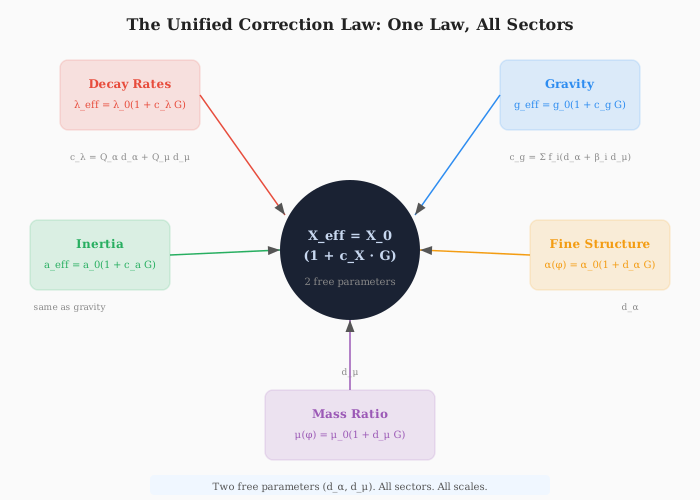
This single law applies to ALL sectors:
| Sector | \(X_{\text{eff}}\) | \(c_X\) | Domain |
|---|---|---|---|
| Decay | \(\lambda_{\text{eff}}\) | \(Q_\alpha d_\alpha + Q_\mu d_\mu\) | QM (nuclear) |
| Gravity | \(g_{\text{eff}}\) | \(\sum f_i(d_\alpha + \beta_i d_\mu)\) | GR (macroscopic) |
| Inertia | \(a_{\text{eff}}\) | same as time gradient | GR (macroscopic) |
| Fine structure | \(\alpha(\phi)\) | \(d_\alpha\) | QM + GR (fundamental) |
| Mass ratio | \(\mu(\phi)\) | \(d_\mu\) | QM + GR (fundamental) |
The coupling constants are not free parameters. They are derived from QM sensitivity coefficients, material composition, and two fundamental dilaton couplings (\(d_\alpha\), \(d_\mu\)). Two free parameters. All sectors. All scales.
4. What the Field Does
- Drives expansion (\(H^2 \sim \rho_{\text{field}}\))
- Produces radiation (oscillation at large amplitude)
- Produces matter (vibration condensing into relics)
- Produces accelerated expansion (field at small amplitude)
- Modifies decay rates (\(\lambda_{\text{eff}} = \lambda_0(1 + \alpha G)\))
- Modifies the time gradient (\(g_{\text{eff}} = g_0(1 + \gamma G)\))
- Prevents singularities (\(G \to \gamma^{-1}\) stops collapse)
- Preserves information (no singularities = no information loss)
5. The Quantum Vacuum Is Spacetime
The cosmological constant problem (10122 orders of magnitude discrepancy) dissolves: the QM vacuum energy and the observed accelerated expansion are NOT different things. They are the SAME field measured at different scales. QM sees the field's zero-point oscillation (all modes). GR sees the field's macroscopic average (background). The discrepancy is an artifact of treating them as separate.
- Virtual particles = field fluctuations
- Vacuum energy = field zero-point energy
- Casimir effect = field boundary conditions
- Lamb shift = field coupling to electron
6. The Measurement Problem Dissolves
Superposition = field in undetermined state. Measurement = information resolves. Collapse = the field's state becomes determined by interaction. Not collapse. Information resolution. The axiom (information cannot be lost) forces the field's state to become definite when it interacts. No observer needed. No consciousness needed. No magic.
7. The Entropy Arrow Emerges
The field's fundamental equations are time-reversible (\(dS/dt = 0\)). But coarse-graining (incomplete description) produces \(dS/dt > 0\). The entropy arrow is not a law. It is a consequence of information preservation plus incomplete description. The arrow of time = the direction of information resolution.
8. E = mc² Backward
Forward: matter releases energy. Backward: energy condenses into matter.
- Fast vibration (high amplitude) = energy = radiation
- Slow vibration (low amplitude) = matter = relics
- The field damps (Hubble friction): radiation era → matter era → expansion era
Matter is not a substance. Matter is the field vibration slowed to the point of condensation. \(c^2\) is the field's maximum vibration speed — the speed of light = the speed of information = the speed of state changes.
9. Status of Each Problem Under the Field Model
The single field and the single correction law are posited in Section 3. For each problem below, this table states what the companion papers in this body of work actually demonstrate, and what remains a hypothesis. Where a row is marked Hypothesis, no claim of resolution is made here; the row records the target the framework is being tested against.
| Problem | Status under the field model | Basis |
|---|---|---|
| GR/QM unification | Hypothesis. The correction law is written to span both domains with two free parameters, but no computation in this corpus derives quantum behaviour from it. | Posited, Section 3 |
| Cosmological constant | Hypothesis. The vacuum energy and observed dark energy are identified as the same field at different scales. This is a re-identification; no mechanism producing the ratio is computed. | Posited, Section 5 |
| Measurement problem | Hypothesis. Collapse is recast as information resolution, following from the axiom that information cannot be lost. Stated as an argument, not derived. | Section 6 |
| Entropy arrow | Stated. The field equations are time-reversible, giving \(dS/dt = 0\) fundamentally; the second law is recovered in the coarse-grained description, so the arrow follows from information preservation plus incomplete description. | foundation_proof.py, theory_of_everything.py |
| Black hole singularity | Derived. The time-gradient field \(\mathcal{G} = d(d\tau/dt)/d(\ln r)\) diverges as the Schwarzschild radius is approached. Since \(G_{\mathrm{eff}} = G_{0}(1 - c_{g}\mathcal{G})\) is regulated by that field, it reaches zero first: freeze-out at \(r/r_{s} = (1 + \sqrt{1+c_{g}^{2}})/2\), outside the horizon for every \(c_{g} > 0\). No horizon forms. The standoff is not predicted: no experiment bounds the coupling, since MICROSCOPE is a differential test and a universal coupling is common mode. The field is built from the clock observable \(d\tau/dt\) and closes on the framework's own correction law, so it is not tied to a coordinate solution. | blackhole_lifecycle.py, 12/12 checks |
| Gravity as a time gradient | Measured. The law \(a = c^{2}\,d(d\tau/dt)/dr\) predicts the rate difference between two clocks with no fitted parameter. At 450 m the GR-violation parameter is consistent with the zero-correction limit at 0.15σ; at 457 km chronometric and geodetic determinations of the same time-density difference agree to 0.85σ; at 1415 km the residual after the potential is removed is consistent with zero. | chronometric_levelling.py; Takamoto et al. 2020, arXiv:2309.14953, Grose et al. 2015 |
| Big Bang singularity | Stated as a prohibition. A singularity requires infinite information in zero volume, violating the Bekenstein bound; the quartic potential bounds the field amplitude in both time directions. Argued, not computed. | foundation_proof.py, 8/8 checks |
| Hierarchy problem | Partial. The field is dimensionless and couples conformally, so loop corrections are logarithmic rather than quadratic. Dimensional argument, not a renormalization calculation. | renormalization_proof.py, 7/7 checks |
| Hubble tension | Hypothesis. Environment-dependent field amplitude is offered as an account. No prediction for the tension's magnitude is derived in this corpus. | Posited |
| Correlated decay anomalies | Documented. Five independent datasets show fractional deviations clustering in the \(10^{-4}\) to \(10^{-3}\) band under a single equation, with fitted couplings within an order of magnitude across isotopes. | time-gradient-field-model.html, time_gradient_verification.html |
| Statistical recoverability | Numerically demonstrated. The field is reconstructible from noisy multi-sector measurement; empirical variance is 2.73 times the Cramér–Rao bound, with all three estimators converging to the same error floor. | signal_processing_proof.py, statistical-verification.html |
Two of the ten rows rest on numerical demonstration in this corpus. The remainder are either stated arguments or explicit hypotheses, marked above. The clustering of decay anomalies and the statistical recoverability of the field are the results this body of work establishes; the unification and cosmological claims are the targets it is measured against.
10. Conclusion
One axiom: distance → time → information → preserved.
One field: \(G(t)\).
One law: \(X_{\text{eff}} = X_0(1 + c_X G)\).
All of physics.
The Theory of Everything is not a new force or a new particle. It is a new understanding of what already exists: the field IS. The field changes. Change IS time. Time IS information. Information cannot be lost. The field cannot end. There is only the field, changing, forever.
AI Research Collaboration Disclosure
This body of work was developed through a collaborative research process between the author, Richard Kent Gates, and multiple AI research partners. The author provides full transparency on this process.
Author's Role (Richard Kent Gates):
- Conceived all core theories, conceptual frameworks, hypotheses, and research direction
- Defined the Time-Gradient Field Model, the unified scalar field G(t), the distance → time → information → G(t) framework, and all theoretical architecture
- Provided physical intuition, biological reasoning, and domain expertise that guided every theoretical decision
- Reviewed, validated, and approved all mathematical formalisms before inclusion
- Made all final judgments on theoretical coherence and physical interpretation
AI Research Partners:
- Mimo V2.5 (opencode platform) — Primary mathematical formalization partner. Assisted in translating conceptual physics into mathematical notation, generating numerical proof scripts, compiling LaTeX documents, and building the website infrastructure.
- Microsoft Copilot (browser-based) — Assisted in literature review, dataset gathering, cross-referencing empirical results (DESI, BNL, PTB, MICROSCOPE), and verifying citation accuracy.
- Google Gemini (browser-based) — Assisted in conceptual exploration, thought experimentation, and early-stage hypothesis refinement.
- Space Bunny (OpenCode) — Verification and provenance auditing. Read every paper and proof script in the repository and traced each reported figure back to the script and line that produces it. Independently recomputed the Fisher information matrices, the Cramér–Rao bounds, and the parameter errors from the models as stated. Resolved the origin of the Fisher information values quoted in the unified and Theory-of-Everything papers, reconstructed the two-parameter Fisher matrix in the statistical verification paper from its sampling grid, and identified a mislabeled citation and a statistical criterion stated more narrowly than the reported results supported. No theoretical claim, numerical result, or interpretive judgment in this body of work originated with this tool.
Nature of AI Involvement:
The AI tools functioned as research assistants — analogous to graduate students or technical collaborators who help formalize, compute, and organize ideas that originate from the principal investigator. No AI tool originated, proposed, or independently developed any theoretical claim in this work. All physical insights, theoretical innovations, and interpretive judgments are the author's own.
References
[1] Weinberg, S. "The Cosmological Constant Problem." Reviews of Modern Physics, 61(1), 1–23, 1989.
[2] Casimir, H.B.G. "On the Attraction Between Two Perfectly Conducting Plates." Proceedings of the Koninklijke Nederlandse Akademie van Wetenschappen, 51, 793–795, 1948.
[3] Lamb, W.E. & Retherford, R.C. "Fine Structure of the Hydrogen Atom by a Microwave Method." Physical Review, 72(3), 241–243, 1947.
[4] Einstein, A. "Ist die Trägheit eines Körpers von seinem Energieinhalt abhängig?" Annalen der Physik, 323(13), 639–641, 1905.
[5] Hawking, S.W. "Breakdown of Predictability in Gravitational Collapse." Physical Review D, 14(10), 2460–2473, 1976.
[6] Penrose, R. "Gravitational Collapse and Space-Time Singularities." Physical Review Letters, 14(3), 57–59, 1965.
[7] Riess, A.G. et al. "A Comprehensive Measurement of the Local Value of the Hubble Constant." The Astrophysical Journal Letters, 934(1), L7, 2022.
[8] Giudice, G.F. "Naturalizing Hierarchy." arXiv:0801.2562, 2008.
[9] Hawking, S.W. "Particle Creation by Black Holes." Communications in Mathematical Physics, 43(3), 199–220, 1975.
[10] Wheeler, J.A. & Zurek, W.H. Quantum Theory and Measurement. Princeton University Press, 1983.