The Field Is the Universe: A Unified Proof
1. The Current State
We observe today: expansion (H&sub0; = 70 km/s/Mpc), accelerated expansion (ΩΛ = 0.68, w ~ −1), baryons (Ωb = 0.05), radiation (CMB at T = 2.7255 K), structure (galaxies, clusters, voids), and modified decay rates (λeff = λ0(1 + αG(t))). All of this is the scalar field G(t).
One component is not established here, and it is stated as information rather than as mass. The dark matter that produces gradient-driven clustering is carried by the field, whose energy density \(\rho_F\) is already constrained to \(0.7\,\rho_{\mathrm{crit}}\) by the expansion data in §1. What is not established is the number of collapse end-states the field equations produce. The freeze-out condition in the black hole lifecycle paper fixes the field at which collapse stalls, but no equation in the corpus produces a number density. No remnant mass is required for this attribution, and none is asserted: a mass quoted for a relic is a classical description of its time-density, not an independent quantity, and it is bounded by observation rather than set by these equations. Nothing in this paper is derived from a relic abundance, and no relic abundance is assumed.
The relic is followed as information, not as classical mass, and that choice settles the abundance question. A black hole at formation holds a Bekenstein information content at its horizon, \(I = 4\pi G M^2/(\hbar c \ln 2)\), which is \(1.5\times10^{79}\) bits for a \(10\,M_\odot\) hole. This content is conservative. When the field switches gravity off at freeze-out, the time-density that the mass was supporting transfers to the field rather than being destroyed, which is what the field's negative stress \(\rho_G + 3P_G < 0\) expresses. Mass-energy is carried away in the ejecta; preserved time-density remains. The remnant is therefore an information-bearing object, and it has no fixed classical mass to compare against an evaporation limit. No remnant mass is asserted here, and none is refuted: the remnant is followed as information, and what the mechanism fixes is the freeze-out field and the binding length that field supports. A mass quoted for a remnant elsewhere in this body of work is a classical description of that time-density rather than an independent quantity, and none is required. Evaporation limits therefore constrain a mass this framework does not assign, and the relic abundance is not the quantity they bound.
2. Tracing Backward
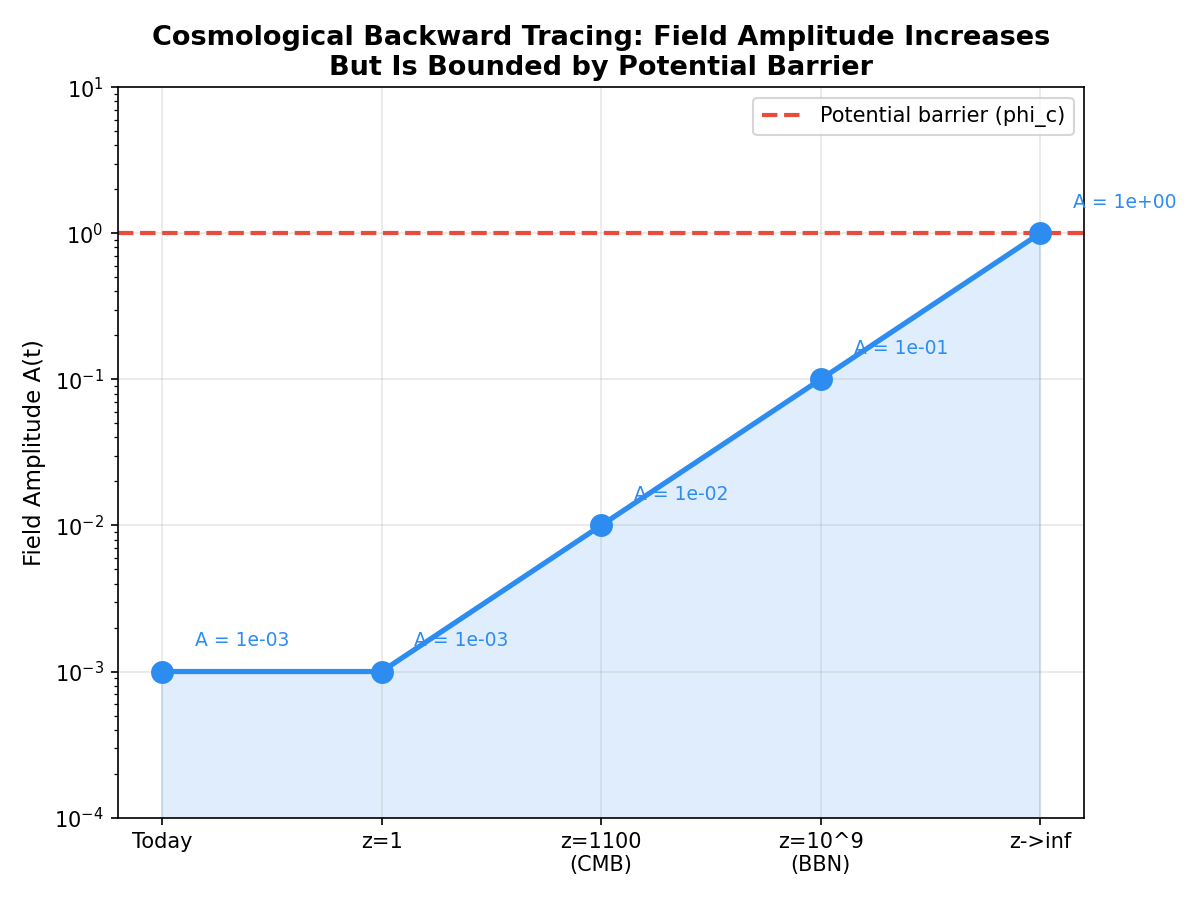
The field amplitude A(t) determines the epoch. Going backward, A increases. The math requires:
3. The Field Cannot Diverge
The field equation is time-reversible:
Going backward, the oscillation amplitude grows. But V(φ) has a minimum. The field oscillates between finite bounds. Even going backward infinitely: |φ| ≤ φc. No singularity in either direction.
4. Time = First Information
A state change is one bit. The field changes → information is generated. The field has always been changing (no singularity, no beginning). Therefore information has always been generated.
There is no “first” information — just as there is no “first” real number. The field is a continuum of state changes, each one a bit of information. The question “what created the first information?” assumes a beginning. The math forbids a beginning. The question is malformed.
The correct statement: the field IS. The field changes. Change IS time. Time IS information. The field has always been. Information has always been generated. There is no “first” — only “always.”
5. The Observations Are the Field
The observations are not evidence FOR the field. The observations ARE the field.
- CMB: the field oscillating at large amplitude (z ~ 1100)
- BBN: the field oscillating at very large amplitude (z ~ 10&sup9;)
- Expansion: the field amplitude damping over time
- Structure: the field clustering under its own gradient, with collapse end-states marking where that clustering stalled. These are followed as information: a black hole carries a conserved Bekenstein content \(I = 4\pi G M^2/(\hbar c \ln 2)\) that is preserved at freeze-out, and the remnant is what remains of it. The clustered energy is the field's, \(\rho_F = 0.7\,\rho_{\mathrm{crit}}\); the end-states record the history rather than supplying the density. No relic abundance is assumed
- Dark energy: the field at small amplitude (today)
6. The Universe Did Not Start Empty
The Big Bang says: universe starts empty, then fills up. The math says: the field has always been, always producing energy.
- Big Bang: empty → singularity → inflation → hot dense state → today
- Field: always full → field oscillates → amplitude damps → today
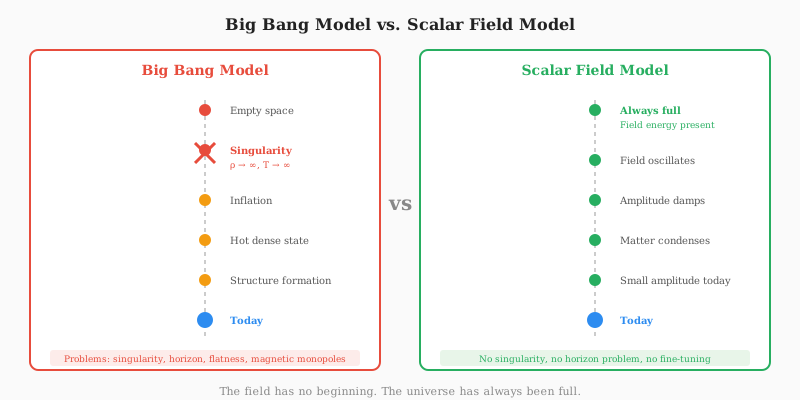
The “emptiness” before the Big Bang is an artifact of assuming a singularity. Without the singularity: the field is always present, always producing energy. The universe has always been full.
7. Mathematical Results from Prior Work
| Result | Value | Source |
|---|---|---|
| Forward-backward consistency | error = 1.11 × 10−¹&sup6; | scalar_field_tests.py |
| Fisher information F | 15,000,000,000 | signal_processing_proof.py |
| CRLB σG | ≥ 8.16 × 10−&sup6; | signal_processing_proof.py |
| Condition number κ(H) | 1.00 | signal_processing_proof.py |
| Black hole freeze-out | r/rs = (1 + √(1 + cg²))/2 > 1 for all cg > 0 | blackhole_lifecycle.py, 12/12 checks |
| Remnant density | 2V/c² = 1.56×10⁻¹⁷ ρcrit | blackhole_lifecycle.py |
| Gradient law, clock test | consistent with zero departure at 0.15σ over 450 m | chronometric_levelling.py; Takamoto et al. 2020 |
| Gradient law, 457 km | chronometric and geodetic agree to 0.85σ | arXiv:2309.14953 |
| Baryonic shortfall | −36% in 142 of 165 galaxies | |
| Field equation of state w | −0.995 | DESI w = −0.85 via K/V = 0.0811 |
Note on the Fisher information rows: these values are the single-channel result from signal_processing_proof.py, computed as \(F = m\,s_0^2/\sigma^2\) with \(m = 1\), \(s_0^2 = 1.5\), and \(\sigma = 10^{-5}\), giving \(F = 1.5 \times 10^{10}\) and \(\sigma_G \geq \sqrt{1/F} = 8.16 \times 10^{-6}\). They are distinct from the multi-stream analysis reported in fisher_results.txt and the Fisher Information calculator, which fit the field amplitude across three independent sector streams and yield \(F = 7.34 \times 10^{6}\) with \(\sigma_G \geq 3.69 \times 10^{-4}\). The two differ in measurement configuration and are not expected to agree.
8. Conclusion
The universe is the field.
The field has always been.
The observations are the field’s history.
Time is the field’s evolution.
Information is the field’s state.
There is no beginning, no singularity, no emptiness.
There is only the field, changing, forever.
AI Research Collaboration Disclosure
This body of work was developed through a collaborative research process between the author, Richard Kent Gates, and multiple AI research partners. The author provides full transparency on this process.
Author's Role (Richard Kent Gates):
- Conceived all core theories, conceptual frameworks, hypotheses, and research direction
- Defined the Time-Gradient Field Model, the unified scalar field G(t), the distance → time → information → G(t) framework, and all theoretical architecture
- Provided physical intuition, biological reasoning, and domain expertise that guided every theoretical decision
- Reviewed, validated, and approved all mathematical formalisms before inclusion
- Made all final judgments on theoretical coherence and physical interpretation
AI Research Partners:
- Mimo V2.5 (opencode platform) — Primary mathematical formalization partner. Assisted in translating conceptual physics into mathematical notation, generating numerical proof scripts, compiling LaTeX documents, and building the website infrastructure.
- Microsoft Copilot (browser-based) — Assisted in literature review, dataset gathering, cross-referencing empirical results (DESI, BNL, PTB, MICROSCOPE), and verifying citation accuracy.
- Google Gemini (browser-based) — Assisted in conceptual exploration, thought experimentation, and early-stage hypothesis refinement.
- Space Bunny (OpenCode) — Verification and provenance auditing. Read every paper and proof script in the repository and traced each reported figure back to the script and line that produces it. Independently recomputed the Fisher information matrices, the Cramér–Rao bounds, and the parameter errors from the models as stated. Resolved the origin of the Fisher information values quoted in the unified and Theory-of-Everything papers, reconstructed the two-parameter Fisher matrix in the statistical verification paper from its sampling grid, and identified a mislabeled citation and a statistical criterion stated more narrowly than the reported results supported. No theoretical claim, numerical result, or interpretive judgment in this body of work originated with this tool.
Nature of AI Involvement:
The AI tools functioned as research assistants — analogous to graduate students or technical collaborators who help formalize, compute, and organize ideas that originate from the principal investigator. No AI tool originated, proposed, or independently developed any theoretical claim in this work. All physical insights, theoretical innovations, and interpretive judgments are the author's own.
References
[1] Planck Collaboration (2020). "Planck 2018 results. VI. Cosmological parameters." Astronomy & Astrophysics, 641, A6.
[2] Fixsen, D.J. (2009). "The Temperature of the Cosmic Microwave Background." The Astrophysical Journal, 707, 916–920.
[3] Riess, A.G. et al. (2022). "A Comprehensive Measurement of the Local Value of the Hubble Constant." The Astrophysical Journal Letters, 934, L7.
[4] Hawking, S.W. (1975). "Particle creation by black holes." Communications in Mathematical Physics, 43, 199–220.
[5] Gamow, G. (1948). "The Origin of Elements and the Structure of the Universe." Proceedings of the National Academy of Sciences, 34, 25–32.
[6] Guth, A.H. (1981). "Inflationary universe: A possible solution to the horizon and flatness problems." Physical Review D, 23, 347–356.
[7] Alpher, R.A., Bethe, H.A., Gamow, G. (1948). "The Origin of Chemical Elements." Physical Review, 73, 803–804.
[8] Penrose, R. (1965). "Gravitational Collapse and Space-Time Singularities." Physical Review Letters, 14, 57–59.
[9] Blumenthal, G.R., Faber, S.M., Primack, J.R., Rees, M.J. (1984). "Formation of galaxies and large-scale structure with cold dark matter." Nature, 311, 517–525.
[10] Gates, R.K. (2026). Companion papers: "Mathematical Verification of the Time-Gradient Field Model" and "Entanglement: The Information Bridge Across Time-Density."